
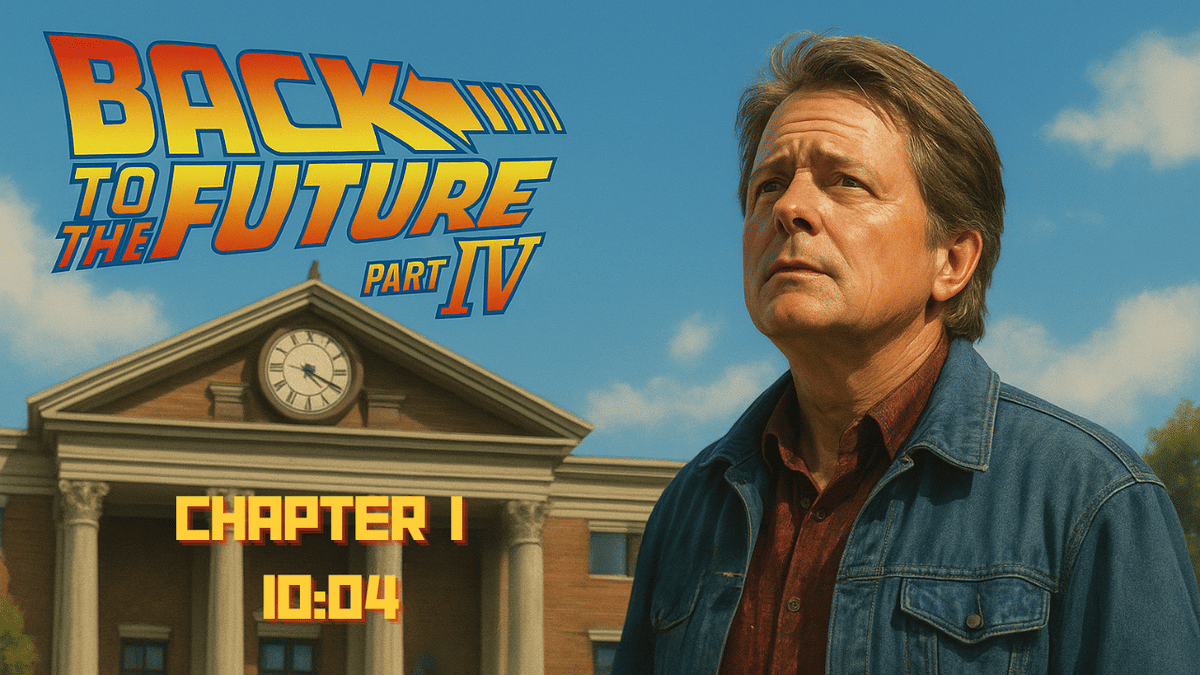
Back to the Future Part IV
Chapter 1
10:04
The rain had just finished rinsing Hill Valley clean when the sun nudged through the clouds and threw a gold band across the old clock tower. The stone steps looked darker, almost freshly varnished, and the puddles along Main Street mirrored the world like dented chrome. The square breathed—cars idled, a bus wheezed by, laughter drifted from a sidewalk table—and yet it felt as if someone had pressed pause on the town years ago and never hit play.
A black truck rolled to a stop in front of the courthouse. The paint had seen better days, but it was still in good shape—much like its driver. The door opened, and Marty McFly stepped out onto the curb. He took off his sunglasses, tilting his head to study the clock tower. The hands were still stuck at 10:04.
“Still busted,” he murmured. “Figures.”
Sliding his sunglasses into his jacket pocket, Marty scanned the town square moving around him: the refurbished facades that pretended they hadn’t once been aerobics studios, the bakery where a coffee shop had been, the new coffee shop where an antique store had been, the empty pane of glass where someone had taped a HELP WANTED sign and borrowed the tape back. Marty looked down at his smartwatch. October 21st, 2015, 4:28 pm. Something in him waited—for a rumble, a crackle, a white-hot stroke of lightning. He even glanced up at the fresh blue sky as if pleading for something to break the eerie silence.
Funny, Marty thought to himself.
I’ve been so many places – times – Doc would be a stickler for accuracy. I’ve been to so many times where -when- I didn’t belong and here I am, right where AND when I should be. But I feel like I need to be anywhere but here. Any time but now?
His smartwatch buzzed, snapping him out of his thoughts. 4:30 PM blinked up at him like a scolding.
Right. Schedules. Mortality. Boxes to pack.
With a sigh, Marty climbed back into the black pickup that still smelled like cardboard and citrus cleaner. He glanced once more at the old clock. Then his eyes returned to his watch and with a final deep breath he pulled away from the curb. The radio came alive mid-chorus—Huey Lewis, a newer track Marty had recorded rhythm guitar for in the studio - without credit. It made him smile and wince at the same time. He cracked a Pepsi, sipped, and let Hill Valley unspool on both sides of the windshield like a film he knew by heart but hadn’t watched in years.
He didn’t notice the tire tracks he left behind.
Oak Park Cemetery was the opposite of the square—quiet, precise, a place that asked you to stop and lower your voice. He parked along the lane and walked the familiar lines of granite and grass. It had been two weeks since the funeral and the dirt still hadn’t settled fully; it never did, really. The new headstone caught light.
GEORGE DOUGLAS McFLY
1938–2015
BELOVED HUSBAND, FATHER, FRIEND
“A Match Made in Space”
Marty exhaled. Everything still felt fresh, so the pain lingered. Marty was somewhat accustomed to it by now, though. After all, this wasn’t the first time he’d said goodbye to his father. It wasn’t even the first time he’d seen his headstone. He brushed rain grit from the marble with the back of his hand.
“Hey, Dad.”
The wind shivered through the trees like a memory walking by. He stood there long enough to forget what else he had planned to say, then put his hand on the stone and nodded. When he turned to go, his eyes focused on another headstone set just in the foreground, as if the cemetery had staged the shot for him.
BUFORD HOWARD TANNEN
1938–2011
“Make like a tree and grow.”
For a second, Marty imagined the granite snorted. Biff really had turned things around for himself before he died, but Marty was the one of the few who understood the irony of the epitaph. He shook it off and headed back to the truck.
Lion Estates had aged the way some actors do—beautiful in the middle and tough around the edges. Some lawns were audition-ready; others had retired. A familiar mailbox leaned inward as if listening to gossip. At the end of the street, his old house wore a fresh door and paint, but the same soul.
Marty’s mother, Lorraine, opened the door before he knocked. Her eyes landed on him, softened, and then squinted as if she was ready to pounce.
“There you are! I was about to call. Did you stop for coffee? You shouldn’t drink coffee this late, it’s not good for your sleep. You look thin, Marty. Or maybe it’s the shirt. Come in, come in.”
Marty let himself be shepherded through the foyer into a living room that had absorbed three decades of family noise and somehow kept its shape. Boxes squatted like faithful dogs at the feet of furniture he’d grown up on. On the coffee table lay a copy of his father’s first book and a stack of old photos: prom smiles, birthdays, that one Thanksgiving where the turkey had briefly doubled as a flamethrower. That wasn’t the only fire that old house had survived. Marty winced at the memory of his parents bellowing at him next to the remnants of the living room rug he’d set fire to when he was eight years old.
I wonder if George and Lorraine went easier on that version of me, Marty wondered to himself.
He supposed not, since he still had the clear and vivid memory of the ordeal. But then again, he remembered his old life too, not the past that had led to this new life after his first trip in the time machine. Doc never really could explain why Marty’s past changed in reality, but not his memory. Marty hadn’t been too concerned about such things then, and Doc wasn’t around now to ask. Marty sighed again, wondering whatever became of his old friend. He’d not heard anything from or about Doc since he watched the time train take off into the sky back in 1985.
Marty and his mother worked. Packing shared a rhythm with music—find the groove, respect the rest. Marty wrapped picture frames in newspaper and felt ink leak into his fingertips like time. Every object wanted to tell a story; the trick was not to listen to all of them at once.
When they took a break, Lorraine poured tea and seemed to give herself permission to exhale. “He kept everything,” she said. “Even the things he didn’t like. Your father… he was so sentimental. That’s sweet, isn’t it?”
“It’s sweet, Mom.”
She studied him over the rim of her mug. “You’re still in Los Angeles?”
“Yeah.”
“And working.”
“I’m working,” he said. “Session stuff. Studios. Sometimes film cues. I’m… it’s steady, you know?” He tried on a shrug that made insecurity look casual. “It’s not like… I mean, it’s not like… stadiums.”
“You don’t need stadiums.” She reached across and squeezed his hand. “You need to play.”
He let that sit in the room and silence filled the air. He’d always wanted other things too—a band that survived the first argument about royalties, a house with a garage full of tools he’d actually use, a kid who looked at the world like it was worth staying up late for.
“Are you seeing anyone now, Marty?” his mother asked with a grin.
Marty didn’t react immediately. His mind now shifted to the various versions of his future he’d both seen and imagined. He was now in one that he’d never anticipated. It could be much worse, after all he’d seen some pretty horrible alternatives first-hand, but he never imagined things would turn out this way.
“Here and there.” He finally replied. “Nobody special though.”
“Well,” his mother started. “I still don’t understand why you and Jennifer ever broke up. I always liked her.”
Lorraine took a sip of her tea; her eyes still locked on Marty. His mother never really had let that one go. He and Jennifer broke up all the way back in ‘93, after Marty’s first big break fizzled out. It was so long ago that Marty couldn’t even remember what caused it all to unravel. Maybe the idea that their future was fated was too much pressure for a couple of kids in their 20s. Doc had always warned Marty it was dangerous to know too much about your own future. Marty’s thoughts continued to echo in his head silently for what seemed like an eternity before his mother’s voice brought him back to the present.
“Are you happy?” Lorraine asked, very gently, like a doctor lowering a stethoscope.
“I’m… here,” he said, and tried to sell it with a half-grin. “Hey, we got through the attic. That’s gotta count for something.”
She nodded, not fooled, and then remembered her errand. “Oh! Speaking of counting—Babs called. Her family runs the youth center in the square now. You remember where the old aerobics studio used to be? They have music nights. I told her you’d stop by and teach a few kids a lesson on the guitar this evening.”
Marty blinked. “You told her what… tonight?”
“They’re underprivileged. Foster kids, mostly. It would be good for you. For you and them.”
“Mom—”
“Your father would’ve loved it.”
He couldn’t argue with a ghost, especially the kind who smiled over a typewriter while a story wrestled itself onto the page. He glanced at the clock and groaned. “What time?”
“Seven.”
He blew out his breath. “Okay. All right. Sure.” He put on a grin that was ninety percent real. “I’ll give ‘em the old ‘Johnny B. Goode’ pep talk.”
“You’ll give them you,” she said, and that landed a big, maternal kiss on his cheek as she got up to keep packing. “Eat something before you go.”
Marty parked his truck in front of the youth center. It felt strange to him. He’d never been to the youth center before, but he’d been inside this very building on this exact same day. In that timeline it had been the Café 80’s. He couldn’t help but wonder why so many things were different from the 2015 he’d seen first. He then wondered what Lou would have thought of all this. History is a game of musical chairs; and Hill Valley never liked standing still for long. Marty knew that much for certain. The front windows were fogged with fingerprints, and Marty could see kids inside. Guitar case in hand, he closed his truck door and walked to the entrance.
Inside, a dozen kids sat with cheap guitars in their laps and cheaper posture. An overworked woman walked up to greet him. Glancing at her name badge—KATIE— Marty watched her face change after seeing him. It lit up like relief had finally taken human form.
“Mr. McFly! Thank you for coming. We’re so grateful you could—”
“Please, Marty,” he said. “Mr. McFly is… unavailable.” He winced. “Sorry. Bad joke.”
“It’s okay,” she said and lowered her voice. “They’re good kids. Not great at showing it. Lot of foster placements, some group homes, a couple no-shows. They were… a little excited when I told them a real musician was coming.” She looked at his hands, the calluses where calluses always lived. “Think you can manage?”
“I’ve been thrown out of worse rooms than this,” he said thinking about the Enchantment Under the Sea Dance. This would be a piece of cake by comparison. He shouldered his case. “All right, gang. Let’s make some noise!”
He started with a few open chords and a dumb joke about blisters. Someone snorted. Someone else actually played in tune. Fingers found strings, then frets, then a shape that could pass for a C major if you didn’t ask it to show ID. Marty cloaked the theory inside story—how he’d learned a lick by watching an older kid in the neighborhood, how rhythm is just heartbeat with manners, how you have to let your mistakes finish their sentence before you correct them. He made it fun, because he knew how to make it fun, and because their faces were armored in skepticism, he wanted to open just enough to let air in. The kids started getting into it.
All except one.
In the back, in a plastic chair with a hairline crack starting on the corner and reaching the spine, a kid with a storm cloud haircut was taking apart his guitar. Literally. The pickguard lay on his thigh like a shell, and he was staring into the cavity like it might reveal the secret to life itself.
Marty drifted the room, letting muscle memory do the teaching, and arrived at the kid without seeming to arrive. “That a vintage model?” he asked softly.
The kid glanced up. Eyes like midnight looking for a reason to be morning. He went back to the screws. No answer.
“You planning to play it, or just see if it fails your inspection?”
A little shrug. “It’s… out of intonation.”
“That so? Well, join the club.” Marty nodded at the room. “Everybody here is out of intonation, tonight.”
A flash of a smile, blink and you’d miss it. Then the face closed again. He had the backplate off now and was peering at the spring claw like it owed him money.
Marty went on, easy. “What’s your name?”
The kid hesitated. Across the room somebody groaned, “Don’t tell him, Space Gun,” and a chorus of snickers followed.
“Hey,” Katie snapped. “Enough.”
The kid’s hands went still at the phrase space gun. Marty filed it away. The kid looked back up, guarded. “Doesn’t matter,” he said.
Marty was suddenly overcome by a feeling inside him that said he was where he should be at that exact moment. As if his future had something to do with it. He thought of Seamus describing that feeling back in 1885. Marty understood all too well what Seamus had been referring to even back then. His memory then flashed back to the day he first met Doc. It was the only other time in his life he’d had the same feeling. A desperate hunt for replacement interocitor tubes turned into a life-changing friendship across time. Marty had never really understood why Doc Brown had been so kind to a random kid snooping around his lab. He always chalked it up to Doc being happy to have someone to talk to about his theories and experiments. Now though, Marty began to think maybe Doc had the same instinct all those years ago. Regardless of the why, he knew that he needed to talk with this boy.
“It matters to me.” Marty said, kneeling down to the boy’s level. He kept his tone sanded smooth. “But we can start with something else. You like games?”
The kid glanced up, unsure. “Games?”
“C’mon.” Marty nodded at the battered arcade cabinet in the corner—SPOOKY SHOOTER, the paint flaking off three rebrands ago. “Five-minute break, guys. Hydrate your fingers.”
He fed the machine a quarter that had traveled in his wallet next to guitar picks and a couple lint ghosts. He let the kid take the first round. The boy’s hands changed the second they were near levers and lights—intent, precise, a little hungry. They played silently, side by side, and the neon carousel voice congratulated them on a high score that probably wasn’t actually high.
“Where’d you learn to take apart guitars?” Marty asked.
The boy said nothing. Just kept looking forward, as if he was trying to come up with the correct words.
“I didn’t know. I just… I just wanted to see how it worked.” the kid said finally.
“Just wanted to know…” Marty echoed, as if it were a lab discipline. “Where are you from, kid?”
The boy’s jaw clenched. “Hill Valley,” he said, in a way that felt true but left out the whole story.
Before Marty could press further, Katie called time. Kids scraped chairs, sighed at chords they hadn’t mastered, tried out swagger they hadn’t earned. The boy started to reassemble his guitar with a clipped efficiency that made Marty want to say, it’s okay to take your time. Time won’t bite you. He thought better of that second part. He knew all too well how hard time could bite.
Marty crouched down again to speak to the kid. “Listen,” he said, softer. “If you ever want to… I don’t know. Talk guitars. Or game scores. Or… anything. I’m around. For a couple days.”
A nod, quick and hard, like the kid didn’t want to jar whatever was fragile inside his ribcage. Then he was up, shouldering the guitar like it weighed nothing and everything.
The door opened to night and bus headlights. The kids poured out like water flowing downhill. The boy didn’t look back.
Marty stood there for a second longer than made sense. He still couldn’t shake that odd feeling, but he knew better than to ignore it.
Katie drifted over, rubbing her eyes the way you do when your day doesn’t believe in clocks. “That one,” she said, and nodded after the kid. “We picked him up a week ago. Cops found him on the outskirts, long road, no houses, driving a car that looked like it never belonged. He doesn’t talk to the other boys. Barely talks to me.”
“He wouldn’t even tell me his name.” Marty said.
She grimaced. “They’ve been teasing him. You heard it. ‘Space gun.’ He told someone something about it and they haven’t stopped mocking him since.”
“What’d he say?”
“That a space gun brought him.” She rolled her eyes, then softened. “He’s scared. They all are. But he’s different. Like he’s listening to something only he can hear.”
Marty’s pulse ticked up. That description hit a little too close to home. He relaxed his face, nodded, thanked her, and made his way to the door. He only knew one other person he could describe that way himself. And the boy did seem awfully familiar.
But it couldn’t be, could it? Marty thought to himself.
He stepped out into the night and headed back to his truck.
He didn’t sleep. He tried, sprawled in his old room. It still smelled faintly of poster tack and laundry that never fully dried. The streetlamp threw the familiar trapezoid of light across the ceiling. He let his eyes wander the edges, tried to trace the exact route his thoughts used to take when he was seventeen and sorting through what the future might want from him.
That was the thing about memory: it’s elastic until it snaps.
He got up. The closet door stuck for a second and then sighed its old sigh. Boxes made their sound—cardboard murmuring to itself. He slid one out, then another. The flotsam of a former life greeted him: a skate wheel, a cassette with the handwritten label half-worn off, now it just said “EDWARD VAN HA”, a photo of a girl with big eyes and even bigger hair kissing his cheek and looking straight at the camera. Jen. He breathed out, slow. The ache was old and domesticated, but it could still bare its teeth if you looked at it too long.
“Guess mom’s not the only one that can’t let that one go.” Marty said to himself.
At the bottom of the second box lay a frame he knew by touch before he saw the picture. He pulled it out. It was the photo he and Doc in 1885, in front of the clock tower dedication, both of them looking as if the world had just told them a secret they couldn’t keep. The mustaches in the background alone could’ve won awards.
“Doc,” he said into the quiet darkness of his room.
What had happened to him? Marty thought about it from time to time over the years. He wanted to believe that he lived out the rest of his days in 1885 with Clara, Jules and Verne. He had no reason to think otherwise. After Doc disappeared in 1985, everyone just assumed he’d gone off on some looney research project and never came back. Marty never corrected anyone. He always kept an eye out for the last name Brown, but that name’s far too common to be a smoking gun on its own. Plus, he figured Doc destroyed the time machine just like he said he would upon returning to 1885. He doubted 130 years later Doc’s great grandchildren would recognize the name Marty McFly.
Marty felt something beneath the frame. Something small, metal, and stubborn. He curled his fingers around it and lifted it into the light.
A key. Not just any key. A key for an ignition that shouldn’t exist anymore.
Marty stood there, holding it like a note bent between chords. His heartbeat did the math. Part of him said, Don’t. Another part said, You know what to do.
He put the frame back. He pocketed the key.
The Hill Valley Police Impound lot lived in that liminal space towns create for their un-resolved stories—chain-link fences, lights that buzzed like insects, a security booth that tried to look awake, but failed. Marty parked in the shadow of a warehouse and listened. The night was quiet. But he knew deep down that something was in that lot that did not belong there.
He scaled the fence with the determination of a decision already made—quickly, before you could talk yourself out of it. On the other side, rows of confiscated cars sat under tarps like witnesses in a blanket fort. He moved through them, counting heartbeats, listening for dogs.
He didn’t need the key to feel heavy in his pocket to know where he was going. He just knew.
And then there it was.
Not under a tarp. Not under anything. Sitting in a puddle of light, as if it had parked there on purpose and told the lamp to cooperate. Stainless steel skin catching the world in soft reflections, gullwing doors closed like ideas waiting for the right question. Mr. Fusion’s dome gleamed with the kind of menace only a tech you trusted could wear.
The DeLorean.
Marty stopped moving. His breath left, came back, did a loop that would’ve made a good rollercoaster. He took a step. Another. The lines of the car rewrote the air as he got closer. He reached out his hand, not quite touching, fingers hovering the way you hover your hand over a campfire to remind yourself you’re alive.
“This is… heavy,” he whispered, and it wasn’t a joke this time.
Something flickered in the corner of his eye: a sticker on the windshield from the impound office, a smeared number, a note that meant nothing and everything. He circled to the rear and popped open Mr. Fusion the exact same way he’d done it before. The lid lifted. Inside: nothing but expectation.
He pulled the plastic bag of garbage from his jacket: candy wrappers, coffee grounds, a crumpled receipt from the youth center vending machine, two bottle caps, the Pepsi can and its remaining contents. He’d had a feeling he was going to need all of it.
As Marty started dumping the contents of the bag, the silence was broken.
Barking.
One dog, then two, then three, a braiding of sound bearing down the row. Floodlights banged to life, a hard white that made the DeLorean’s skin look like armor. The alarm wailed, late to the story but eager to make up for it.
Marty snapped his head toward the fence. Shadows moved. The security booth flared red, then blue. He looked back at the DeLorean, at the open mouth of Mr. Fusion, at the key in his pocket, the impossible crouched in front of him.
He dumped the rest of the bag’s contents, then the bag itself.
The growl of the dogs swelled, claws scrabbling against asphalt. Getting louder and louder as they closed in. Marty’s hand found the driver’s handle without looking. It was an old friend, after all. He yanked the door up — the gullwing gasped. He slid into the seat that fit exactly as he remembered. The interior smell punched him in the chest—he’d already gone back in time without turning the ignition.
His fingers found the familiar switches and levers. The battered glory of the time circuits. He breathed once, hard.
The dogs were almost at the door now. A guard shouted something Marty couldn’t hear, but he believed the authority.
Marty felt the key like a held breath.
He flicked his gaze to the time circuits. LAST TIME DEPARTED winked in and out, scrambled letters trying to behave: OCT 16, 1935, 07:02 PM. The readout hiccupped and glitched, disappearing and reappearing just like Marty’s hope of getting out of there. He smacked it with his hand, because some rituals aren’t superstition; they’re code.
The barking dogs hit the door. The DeLorean shook.
“Okay,” he said to nobody. Making his final decision.
Another shout. Footsteps. Radios coughing into life.
Marty’s hand closed around the key, and the shape of it told his fingers who he was again.
He hesitated, just long enough to know that he was hesitating. Lightning without a storm. A clock that thought it could freeze time by refusing to move.
He turned the key—
—and the DeLorean came awake with a sound that history had written for it and only it.
Marty tightened his grip on the wheel and stepped on the gas.
To be continued…
This is a fanfiction novel based on the concepts and characters from Back to the Future, created by Robert Zemeckis and Bob Gale. It is also based on concepts from Channel Awesome's What If Back to the Future Part IV Happened? video.
A quick note from the "writer":
My ethics told me this little note should really go at the beginning, but really if you've made it this far, you're here for the story. I'm simply compelled to be completely truthful. I've been a fan of Back to the Future for about as long as I can remember. It's one of those sets of movies that when you were channel surfing and it was on, you stuck around and watched. All of them. I was also a purist, believing that the movies were perfect and nothing needed to be added to the story. Then, a few years ago, I stumbled upon a video on YouTube from Channel Awesome's series: Fanscription. This video laid out his idea for what a Back to the Future Part IV could look like and I loved it. I loved how it furthered the story, evolved the characters and mostly, showed real consequences for everything that happened in the previous movies. I treated that video as a legitimate part 4, and made it mandatory viewing of the series whenever I watched it. That video, however, was only an outline and I craved the full story, knowing full well that I would never get it. This movie would never be made and even if it were, it would likely be very different form what was laid out in this idea. And I'm no writer, so I figured this was all I was going to get.
Then... I started working with AI more and more. If you follow any of my channels, you know my feelings about art and AI. However, I reasoned that with just a little help structuring everything with AI, I could take this outline and fill in the blanks in a way that gives me the story I craved while respecting the original source material as well as Channel Awesome's incredible idea. Like I said earlier, I'm no writer, but this IS my voice. I just got a little help from my artificial intelligence editor.
I am not now, nor will I ever be, looking to make money off of this project. This is literally being made just for me, but I'm putting it out there just in case anyone else may enjoy it. If you don't, believe me I get it. I'm not even saying this story SHOULD be a continuation. I just want it for myself. That being said, I hope you do enjoy it and I look forward to releasing the new chapters monthly. There are some great twists and moments coming up.
Your friend in time,
Jake Boger