
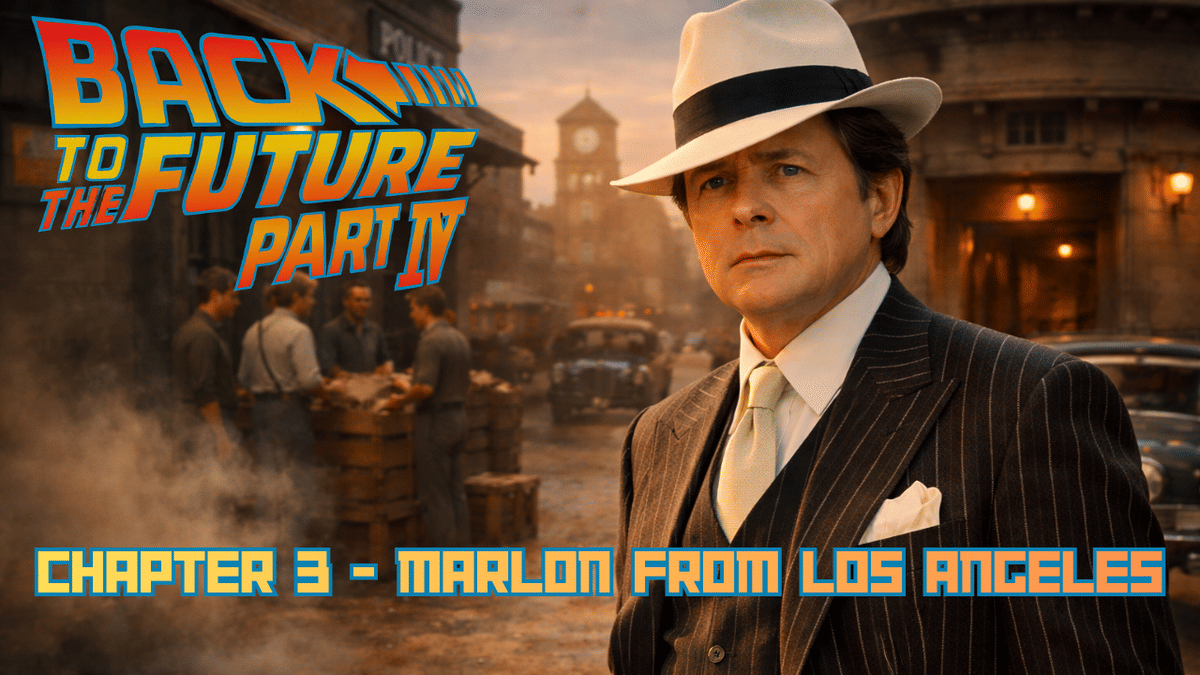
Marty woke to the sound of a pencil moving across paper.
For a few seconds Marty didn’t move. He lay on the narrow cot and let the room come into focus around him, the way he’d learned to do after too many mornings in too many wrong years. The carriage house was dim, the high windows admitting only a pale wash of early light. Dust floated in it, slow and lazy, as if time itself had decided to take it easy today.
He turned his head.
The DeLorean sat completely hidden beneath a heavy canvas tarp. Just a broad, unnatural shape, slumped in the corner like a large animal asleep. If you didn’t know what it was, you might have mistaken it for an old piece of farm machinery somebody never got around to selling.
The pencil continued.
Marty shifted his gaze toward the worktable.
Emmett sat on a wooden stool, perched forward with his shoulders slightly hunched and one foot hooked around the stool’s lower rung, his sleeves rolled up unevenly—one pushed neatly to the elbow, the other stubbornly refusing to stay. His hair was already in that familiar state of rebellion, like he’d run his hands through it a few dozen times.
The worktable had been claimed completely. Several large sheets of paper were spread out and weighed down with whatever Emmett had within reach: a wrench, a small jar of screws, a thick book with a cracked spine, and a metal ashtray that looked like it had never actually met an ash.
Emmett leaned closer to the paper, pencil moving in short, decisive strokes. Every few seconds he paused, tapped the pencil against his teeth, and made a note in the margin in smaller handwriting.
Marty watched him for a while, captivated by seeing those mannerisms he recognized so well, but in a person he’d just met. That’s the funny thing about time travel, this WAS Doc Brown, but not the one he knew. After his first adventure through time, Marty understood that past versions of people are always oddly similar to the versions we know, and simultaneously very different. It was strange, seeing Doc like this. Not Doc. Not yet. Marty’s mind kept trying to snap the image into a shape it recognized: wild-haired scientist, lab coat flapping, hands flying as he explained something impossible like it was just the obvious next step. But this Emmett was different in ways that weren’t just age. He had a focus that felt… rawer. Less practiced. Like a fire that hadn’t learned yet which direction to burn.
Marty yawned and stretched his arms out. He had work to do, and it was time he got started.
Emmett startled so hard the pencil slipped from his fingers and rolled across the table until it bumped softly against the jar of screws. He turned, eyes wide, then immediately brightened as recognition caught up.
“Oh!” he said, voice low but excited, as though speaking too loudly might break the fragile peace of the morning. “You’re awake. I didn’t want to disturb you.”
Marty pushed himself up on one elbow. The cot creaked in protest. “You know,” he said, voice thick with sleep, “most kids your age sleep in.”
Emmett blinked, then glanced back at the papers like Marty had complimented them. “I couldn’t sleep,” he admitted.
Marty sat up, rubbing his face. “Yeah. Last night was certainly an…experience.”
Emmett’s mouth twitched as if he knew that was supposed to be funny but didn’t have time to decide whether to laugh.
He gestured to the table. “I was reviewing my original schematics.”
Marty swung his legs off the cot and stood. His back complained. He tried not to show it. “Original schematics for what?”
Emmett hesitated, then slid one of the big sheets toward the edge of the table where Marty could see. The paper was heavy and slightly yellow. The lines were clean and deliberate, but it was clear they’d gone through several revisions.
It took Marty a moment to parse what he was looking at.
A microphone. A cable. A box strapped to the body. Another box. Several labels. Battery compartments. Tubes.
Marty stared blankly. “Is that… a radio?”
“No,” Emmett said quickly. “Well— not for transmitting. It doesn’t send anything. It listens.”
Marty studied the schematic closer. “So, it’s like… super hearing?”
Emmett winced the exact same way Doc would wince when Marty described complex physics as ‘stuff.’ “Not exactly. It’s not meant to make everything louder. Well, at least not anymore. It’s meant to make one thing clearer.”
He tapped the drawing where the microphone was sketched. “The microphone converts sound into an electrical signal. The amplifier increases the signal strength—”
Marty leaned on the edge of the table and tried again. “So this thing… helps somebody hear better?”
Emmett nodded quickly. “Yes. But not in the traditional sense. The existing hearing instruments—well, the newer ones—amplify sound. All sound. But the problem is that in a busy environment, amplification can become… chaos.”
Marty stared at him. “So you’re trying to… pick out one voice.”
Emmett’s face lit up. “Exactly! That’s exactly it.”
He leaned forward, excited now, and began turning pages. Marty saw variations of the design: different shapes for the microphone, different layouts for the amplifier pack, a more compact battery housing that Emmett had angrily crossed out with the note INSUFFICIENT CURRENT.
“But,” Emmett said, and there was a real frustration in the word, “vacuum tubes require power. Power requires batteries. And batteries are heavy. Even in the best arrangement, the user would have to wear the amplifier pack like—”
Marty gestured. “Like a suitcase.”
Emmett exhaled. “Yes.”
He leaned back on the stool, gaze dropping to the paper again. “This is just— this is the initial design,” he said, more quietly. “The concept matters. The execution… well. It needs work.”
Marty nodded, but his attention had already begun to drift.
It wasn’t because he didn’t care. It was because his mind was full of other things that demanded space.
Kid Tannen.
Eddie Black.
The men who had taken Emmett.
Judge Brown’s name, the weight it carried.
The fact that Marty had seen enough of history to know that when crime, power and Tannens mixed, bad things happened.
He glanced again at the tarp in the corner. The DeLorean looked like a sleeping promise that could turn into a nightmare if he handled it wrong.
Emmett mistook Marty’s silence.
“I know it’s unfinished,” Emmett said quickly. “And it may never work as intended. But the underlying principle is sound. Sound is energy, and energy can be shaped, filtered, interrupted—”
Emmett stopped. His hands hovered over the paper. He looked suddenly younger.
Marty noticed the shift and shifted himself back to their conversation.
“Hey,” Marty said gently.
Emmett met his eyes, and Marty saw something there that made his chest tighten—something that was both confidence and doubt, like two opposing magnets forced too close together.
“If you put your mind to it,” he said, “you can accomplish anything.”
Emmett blinked.
Marty cracked a smile, “I don’t totally understand the whole… suitcase hearing thing yet. But I do understand one thing.”
He tapped the paper lightly with two fingers.
“If anyone can figure this out, it’s you.”
Marty shrugged, trying to keep it casual, because making it heavy would make it embarrassing for both of them. “So keep going. Keep making it better. Figure it out.”
He meant it. Completely.
But even as he spoke, his mind was already shifting again—thinking about where he’d start in town, what questions he could ask without sounding like a cop, what face he needed to wear to get close to Kid Tannen without getting his teeth knocked out.
Emmett nodded once.
It wasn’t a timid nod. It was sharp, decisive, like he’d just accepted a mission.
“I will,” he said simply.
Marty watched him return to work and felt something strange move through him.
It wasn’t pride. Not exactly. It was more like… a recognition of the shape of things. Like seeing the first line of a long story and realizing you already knew how it ended.
“Alright,” Marty said, stretching his arms. “I’m gonna go take a look around town. Find out what’s what.”
Emmett turned around on the stool, eyeing Marty up and down.
“You’ll need something to wear.”
Marty found himself standing in the town square of Hill Valley once again. Sunlight was already climbing the buildings in the early morning. Hill Valley was awake in that steady, practical way that suggested it had been awake long before he arrived and would remain so long after he left.
The place felt familiar before it felt strange.
The streets ran where they always had. The square opened the same way. The buildings leaned at angles he recognized, but these were even older than his parents, but much more familiar than 1885 Hill Valley. By 1935, the bones were there for the town he recognized. Even the sound of the place made sense at first—wagon wheels clattering across brick, engines coughing awake and settling into low, patient idles, voices calling out names and prices and instructions that didn’t need repeating.
Hill Valley worked for a living.
The air smelled like coal smoke and soap and fresh bread, with a faint metallic edge underneath it all. Marty took a few steps forward, letting himself drift rather than choosing a direction, his eyes already scanning ahead. He was thinking about where he might start. Who might talk. Who wouldn’t. The questions stacked up easily, the way they always did when he was dropped into a new version of the same old place. But this time, Marty was used to the uncertainty. He’d been down this road before. Literally and figuratively. Even temporally.
Marty’s mind was so occupied thinking of where to start, that it took him longer than it should have to notice their gazes. Much longer than the people around him. At least their expressions gave that impression. Not stares, at least not outright. Just small hesitations. A man trailing off midsentence, then picking back up again as Marty passed. A woman pausing with a basket on her hip, watching him go by before remembering she was in the middle of something. A laugh that cut off too quickly, like someone had realized it might carry.
Marty slowed. Hill Valley had always been curious about strangers, that much he’d learned from all the times he’d been a temporal stranger. That alone didn’t mean anything. But this felt different. More focused. Less casual.
A kid stared at him openly, head tilted, eyes wide, until his mother caught sight of it and tugged him close with a sharp whisper. Two men near a delivery truck leaned together, then separated as Marty approached, both suddenly very interested in the truck’s back tire.
Marty frowned, not alarmed so much as confused.
He took another step. Then another.
Someone muttered something he couldn’t quite hear. Someone else laughed, short and surprised, and then stopped.
Marty glanced down.
The suit stared back at him.
In the open daylight, with nothing to soften it, the thing had presence. Bold pattern. Wide lapels. A cut that suggested movement, noise. Not to mention the fedora completing the ensemble. Sure, it didn’t match the suit at all, but Marty had insisted on it rather than the gaudy top hat that went along with Erhardt’s old suit. It was wrong for the decade—just a bit past its prime—It belonged more in the roaring 20s, when liquor and money flowed freely, not the Depression where neither was common and only the outlaws had plenty of both. It wasn’t subtle at all, but it was better than his clothes from 2015.
Marty blinked.
“…Huh.”
That was the full extent of his analysis.
He didn’t panic. Didn’t consider turning around. Didn’t start cataloging ways to explain himself. He just did what he always did when something about him suddenly became a problem he hadn’t planned for.
He adjusted. If he’s wearing it, he might as well wear it.
His shoulders rolled back. His stride loosened. He let his arms swing a little wider, like the suit was a choice. Like it was exactly what he meant to be wearing, and anyone who thought otherwise was missing the point.
Confidence, Marty had learned, worked best when you decided to have it after the world forced your hand.
He began crossing the square again, this time more deliberately, and that was when the building caught his eye.
A wash-a-teria sat across the street, steam fogging the windows from the inside. A hand-painted sign promised CLEAN CLOTHES — FAIR PRICES, the lettering uneven but earnest. The steady clatter of machines leaked through the door every time it opened, a familiar mechanical rhythm layered beneath the sounds of the town.
Marty stopped.
He didn’t really see the wash-a-teria at first.
He saw the Youth Center—bright, loud, alive with futures that hadn’t happened yet.
He saw Café 80’s, all neon and bravado and nostalgia gone sideways.
He saw Lou’s Café, warm and ordinary and exactly where it belonged.
Same place. Different decade. Same bones.
“Well,” Marty murmured, hands settling into his pockets, “this place has always worked before.”
He crossed the street and went inside.
Heat hit him immediately, warm and damp, heavy with soap and wet fabric. Rows of machines rattled and churned, belts squealing softly, water sloshing behind glass. Women moved between them with practiced efficiency, sleeves rolled, faces set in expressions that suggested they had neither the time nor the patience for interruptions.
Marty drifted toward the counter, catching his reflection in the warped glass of a washer as it bent and stretched his outline. The suit looked even louder in here, the pattern fighting with the motion behind it.
Marty continued towards the counter. He saw a woman behind it with a cash register next to her. Must be the owner, he thought to himself. Marty was no expert, but he knew enough about history to reason that during the Great Depression, a business owner would only trust themselves with the money. And if the owner worked the counter, she talked to people and probably heard some things. Marty straightened his lapels and made his way to the counter.
“Morning,” he said easily.
The woman behind the counter perked up, looked Marty up and down and returned the greeting not quite sure what to make of him.
“Good morning…”, she said, going back to her ledger. “How can I help you? Are you wanting to have that cleaned before the next party?”
Marty could tell she was joking just a little with that last remark, but he didn’t have time to be subtle. His expression instantly went from friendly to serious.
“I’m lookin’ for someone.”
The woman behind the counter didn’t move her head at all. “Aren’t we all.”
Marty grinned. “I hear a guy named Kid runs things around here.”
That did it.
Her hands stopped moving. Slowly, deliberately, she looked up at him. Not startled. Not confused. Assessing.
Her eyes traveled over his face.
Then dipped.
To the suit.
Her mouth tightened.
“You from around here?” she asked.
“No, ma’am.”
“That figures,” she said. “Nobody from Hill Valley wears something like that unless they’re tryin’ to make a point.”
Marty glanced down again, then brought his eyes back up just under his hat. Just like his favorite gangster movies “Exactly.”
“Well, I don’t know who you’re talkin’ about.” she said sharply, “And I don’t want no trouble.”
“No trouble,” Marty said calmly. “Just askin’.”
“Well, you can ask somewhere else.”
There was no anger in her voice. Just caution, sharpened by experience. Marty recognized it instantly. He’d heard it before, in different decades, in different rooms.
He nodded. “Fair enough.”
He turned toward the door.
“And for your own good,” she added, not unkindly, “you might want think twice about asking somewhere else.”
Marty paused, then smiled over his shoulder. “I’ll keep that in mind.”
Outside again, he walked along the side of the building, the sound of machines fading behind him.
Think twice, he thought. Marty started to wonder what in the world was going on. Based on how that woman was talking, this Kid Tannen seemed a lot more dangerous than the breed of Biff’s lineage he was used to. He might be in over his head. Scratch that, he was definitely in over his head. But this time, he was alone. No Doc to help him figure things out. Marty stood outside the wash-a-teria, trying to come up with the next step.
Then he heard the clink. Glass, touching glass. It was coming from behind the building.
He rounded the corner and found the alley. Crates were stacked neatly near a service door. A group of men were unloading them from a truck with quiet efficiency, no wasted motion, no raised voices. The smell hit him a second later.
Liquor.
“Oh,” Marty murmured. “Right.”
Marty walked closer and began to hear them talking as they worked.
“Why’s it always gotta be us unloadin?” One man said to another, sleeves rolled up and sweat dripping down. “Why can’t we ever be the ones sortin’, or shakin’?”
“Cause the boss told us to unload, so we unload” said the other man. Older and clearly more experienced.
One of the men looked up and froze when he saw him. For a moment, no one moved.
Marty raised his hands slightly, palms open. “Hey. You guys need a hand?”
The older man closest to him squinted. “You a cop?”
Marty laughed, genuinely. “With this?” He gestured at himself.
The man’s eyes tracked over the suit again.
Another guy snorted. “If he’s a cop, he lost a bet.”
“Or wandered out of a costume party,” someone else said.
Marty grinned. “Hey. Everybody needs a hobby.”
The older man analyzed Marty from head to toe, more cautiously than his younger compatriots.
“Never seen you before.” He said, “And I seen everybody. And with that getup, I’m guessin’ you ain’t too worried about gettin’ rolled.”
Marty didn’t know how to respond to that. His mind raced trying to come up with a good cover story, but he just didn’t know enough to sound legitimate. So, Marty did what he always did in these situations. He bluffed.
“Very perceptive.” Marty said, bringing his hand close to his face and rolling his fingers together, as if he didn’t have a care in the world. It worked.
“He must be with the LA outfit.” One of the younger men chimed in.
Bingo
“Button it!” the older man snapped.
But it was too late. Marty had what he needed.
“Nah, he’s right.” Marty continued returning his eyes to them. “I am from LA.”
Technically not a lie.
“So what are you doin’ here big shot?” The older man pressed. “And what did you say your name was?”
Marty couldn’t back down now, he almost had it. He’d dealt with enough thugs in his life to know you have to meet them eye to eye. Even when they’re taller. He’d also learned a few lessons from his previous travels to the past. He knew he’d need a name, and he’d already come up with one.
“Brando.” He said, “Marlon Brando, from LA”.
There was a pause. Looks exchanged. Then a shrug.
“Grab that end,” someone said.
Marty stepped forward and hoisted a crate. It was heavier than it looked, and he adjusted his grip with a grunt.
One of the men nodded once. “Careful there, Hollywood.”
Marty smirked. “You should see the rest of the outfit.”
And just like that, he was in.
With Marty’s help the work went faster. And the men seemed grateful for it. Once the question of whether he belonged there had been quietly dismissed, the men went back to what they were doing without ceremony. No introductions. No instructions beyond the occasional grunt or gesture. Marty learned quickly that if you watched first, no one needed to explain anything to you.
He carried when they carried.
Waited when they waited.
Didn’t ask questions.
That alone seemed to count for something.
The older man—the one who’d asked if he was a cop—kept an eye on him without making it obvious. Marty noticed how the man corrected him once, firm but calm, when he stacked a crate the wrong way.
“Bottle necks up,” the man said. “Always.”
Marty adjusted his grip. “Right.”
They finished unloading in near silence, broken only by the scrape of wood on concrete and the dull clink of glass. When the last crate was moved inside, the service door was shut and locked.
No wonder that woman didn’t want to talk to him, Marty thought to himself. She’s running a full-blown speakeasy under or behind her laundromat. Marty had to admit it was perfect cover, but also now understood that she would never have wanted to give any information about her supplier. No one had come out and said it, but Marty was sure these were Kid Tannen’s men.
One of the younger men wiped his hands on his trousers and glanced at Marty.
“You’re stronger than you look, big shot.”
Marty smirked faintly. “It’s the suit.”
That earned a short laugh. Nothing loud. Nothing lingering.
They moved on almost immediately.
That surprised Marty more than anything else. No hanging around. No celebration. Just a shift in direction and purpose, like the work itself had flipped a page.
“All right,” the older man said. “We got a couple more.”
The next hours blurred together into motion and place. A delivery left at a boarding house where no one asked questions. A quiet pickup that didn’t seem like much until Marty noticed how carefully it was handled. He began to recognize the pattern—how people stepped aside without being told, how eyes slid away just before meeting his.
This wasn’t chaos.
It was maintenance.
At one stop, while the others were inside, Marty lingered near the curb with one of the younger men, told to keep watch. The guy was thin, restless, always shifting his weight like he was afraid the ground might move under him. He kept glancing back toward the door. Marty had noticed him earlier. He looked oddly familiar, but he couldn’t place him. Marty knew it was probably just his mind playing tricks on him, so he dismissed it. But now, the silence was beginning to bother him, so he struck up a conversation. Maybe he could learn something without the old man watching over them.
“You new?” Marty asked, finally.
“Yeah,” he said nervously. “Well sorta. Started about six months ago.”
Marty nodded like that explained everything.
“Name’s Frank.” The young mad said, extending his hand.
“Frank,” Marty repeated. Stretching out his hand casually into the handshake.
“Frank Baines.”
The name landed harder than Marty expected. Like a sudden drop, the kind that made your stomach float.
Baines. As in his mother’s maiden name Baines. Marty tried to keep his face neutral. But a little bit slipped through.
Frank noticed the flicker in his expression.
“Yeah, I suppose you may have read my name in the papers. I screwed up. But Kid said for sure I wouldn’t get in no trouble. He’s making sure the judge is gonna let me walk”.
Marty froze for just a moment, then snapped back.
“Nice to meet you,” he said.
Frank smiled, relieved by the normalcy of it. “Likewise. You from LA, then?”
“So I’m told.”
Frank chuckled. “Figures. You got that… movie look about you.”
Marty glanced at the suit. “Yeah. I get that a lot.”
Frank leaned against the wall, lowering his voice. “Yes sir, you don’t gotta worry about nothin’. Kid takes care of his people.”
Marty studied him for a moment. The resemblance wasn’t exact, but it didn’t need to be. The eyes were wrong—too sharp, too tired—but the shape of the face, the way he talked when he thought he was being helpful… it was all there.
Uncle Joey. Or at least the echo of him.
Marty felt something twist in his chest and forced himself to breathe through it. He’d seen this before. Ancestors and descendants, repeating the same rhythms without knowing why.
More importantly though, Marty now knew for sure that these were Kid Tannen’s men. Frank hadn’t made the connection that Marty didn’t know that yet. He probably just assumed Marty knew who he was searching for. No matter, this kid’s inexperience just cemented that he was in the right place at the right time. Even though it was the wrong time. Marty was starting to see where Uncle Joey’s “bad luck” came from.
“Yeah,” Marty said quietly. “That’s what I hear.”
The door opened behind them, and the moment broke. Time to move on.
By the time the last errand was finished, the light had changed. Not evening yet, but close. The shadows stretched longer now, thinner, slipping between buildings like they knew where they were going.
The older man stopped near a corner Marty didn’t recognize. Around the corner sat a clearly abandoned building. But lights were on. Marty could just barely make out the word “Police” between the broken wall and the boards on the side of the building. Marty was instructed to wait outside while the men went in.
Marty put his ear up the wall, trying to hear something, anything, but he couldn’t make anything out. Anything he did hear was too muffled to make sense. Only a few seconds after Marty decided it was probably best to not look like he was snooping, the door swung open and the older man was there.
“You did all right,” he said with a nod of approval.
Marty returned a small nod of his own. “Appreciate that.”
The man studied him for a moment then softened his expression just a bit, then said, “Kid wants to see you.”
He motioned Marty to come inside with him. Marty felt a familiar tightening in his jaw. For a split second, the image of the DeLorean under its tarp flashed in his mind: silent, hidden, waiting. Not every mistake with a Tannen had started like this—but enough of the bad ones had. A quiet room. A man who already thought he’d won. Marty exhaled once, slow and controlled, and reminded himself he wasn’t a kid anymore.
Inside, no one made a sound. A man stood near a desk, jacket off, sleeves rolled up. He turned as they entered, eyes sharp, already taking Marty apart piece by piece. Marty recognized him immediately, even though they’d never met before.
Kid Tannen.
He looked almost exactly like Biff, just with darker hair and the thinnest pencil moustache.
Kid’s gaze lingered on Marty’s suit.
Then lifted.
“That’s quite a getup,” Kid said.
Marty shrugged, casually. “If you hide in plain sight, the right eyes will find you.”
Kid smiled at that. Not friendly. Not hostile. Curious. Though Marty could tell he liked what he was hearing.
“Yeah,” he said. “They usually do.”
He gestured to a chair, turning serious. “Sit down, Brando.”
Marty sat, adjusted his coat, and looked yet another Tannen from another time dead in the eyes.