Misunderstood Economics, Misused Names
This blog post was originally going to be about a very interesting phenomenon: the way we sometimes glorify people who do bad things—so long as they’re doing them to people we dislike at the moment.
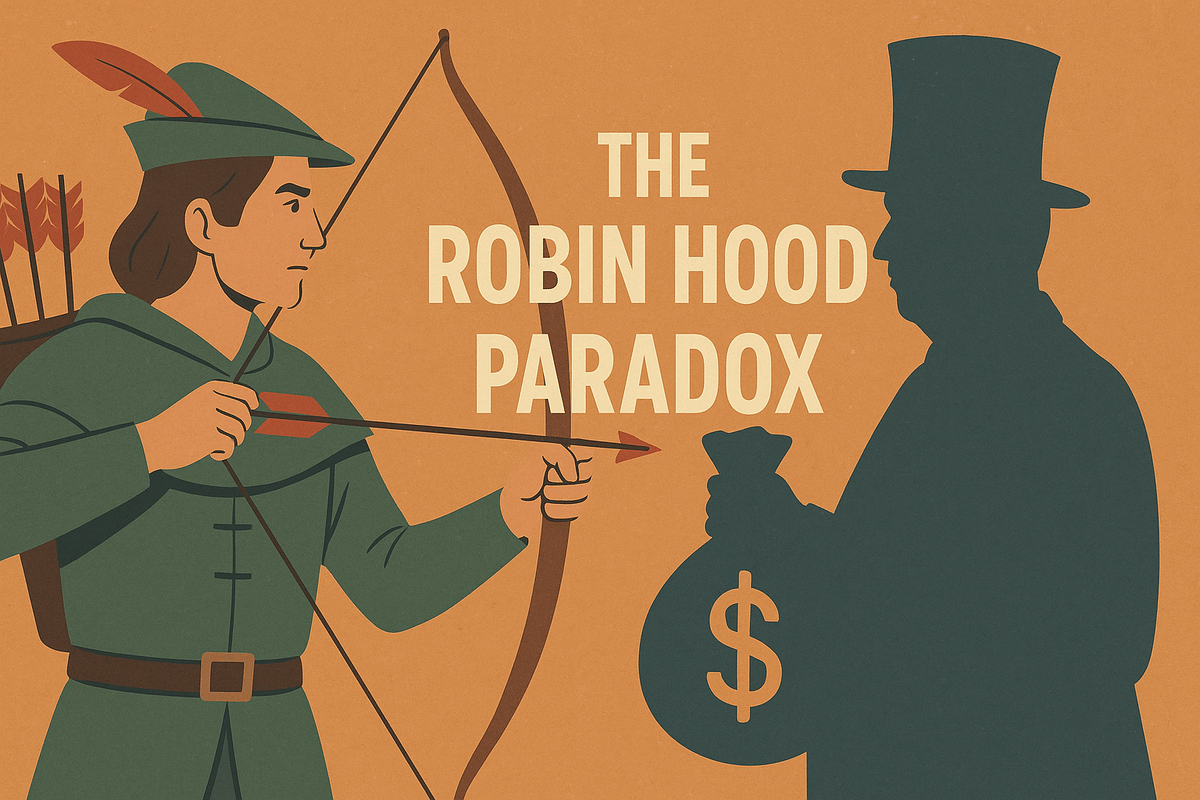
In my mind, I had coined this idea “The Robin Hood Paradox,” after the legendary outlaw we all know and (mostly) love. Throughout history, people have been elevated to hero status for committing harmful or even evil acts—just because their targets are considered worse. Think Josef Stalin during WWII (an ally against the Nazis, despite being a brutal dictator), or more recently, someone like Luigi Mangione (depending on the outcome of his case). I still believe in the principle of “innocent until proven guilty”… except for O.J. That MF’er definitely did it. Also—Alabama fans cheering for Auburn when they play LSU. I get it. I’ll definitely write more on that idea soon.
But here’s the twist: apparently, the term “Robin Hood Paradox” already exists—just not in the way I intended. So instead, let’s talk about what that version of the Robin Hood Paradox means, and why I think the name is a misfire.
What Is the Robin Hood Paradox?
The term, as defined by the Russell Sage Foundation, refers to:
“The counterintuitive relationship between income inequality and redistribution in democratic countries.”
In simple terms: countries with higher income inequality tend to have less wealth redistribution, while those with more redistribution have lower inequality. It seems like a paradox—but is it really?
Why This Isn’t a Paradox
Let’s pause for a second. A paradox is defined as:
“A statement that seems self-contradictory or absurd, but in reality expresses a possible truth.”
So, let’s analyze the logic: if redistribution reduces inequality, then naturally, countries that redistribute more will have less inequality. That’s not contradictory—it’s expected. If Joe has $100 and Anne has $0, and Joe gives Anne $50 (voluntarily or through taxation), then inequality decreases. Even if he gives her $30, the economic gap is still smaller. That’s not paradoxical; it’s cause and effect.
So, if we’re treating this as a logic problem, it shouldn’t be called a paradox. It’s a formula.
Irony in the Robin Hood Analogy
It’s also ironic that this economic concept borrows the name Robin Hood, because most depictions of Robin Hood are anti-tax, not pro-government redistribution.
In classic tales, Robin Hood steals from the rich (usually corrupt nobility) to give back to the poor—often to refund unjust taxes taken by the state. He’s not pushing for government-managed wealth redistribution; he’s rebelling against it. In essence, he’s giving the people an unofficial tax rebate. Who knew Robin Hood was a libertarian?
So, not only is the “Robin Hood Paradox” misnamed because it isn’t a paradox, it’s also misnamed because Robin Hood himself wasn’t really a fan of government redistribution. He was more of a freedom-fighting tax protestor than a champion of state-run welfare programs.
Let’s Talk Ethics and Assumptions
The so-called Robin Hood Paradox rests on two big assumptions:
There is a direct relationship between redistribution and inequality.
Wealth redistribution is inherently good.
The first assumption is plausible, and depending on how “redistribution” is defined, supported by data. The second is more debatable.
If we define redistribution as using tax revenue to invest in infrastructure, education, healthcare, emergency services, and public safety—then yes, it’s hard to argue against its value. These are collective investments that benefit all citizens. Even skeptics might agree that paved roads, functioning hospitals, and disaster response teams are good things.
But if redistribution means direct cash transfers from the rich to the poor, the morality and effectiveness become far more complex. This is where socialist-leaning theorists often go wrong: they assume that all poor people are inherently wise, just, and responsible—and that a simple increase in wealth will solve all their problems. That’s true for some, but not enough to build comprehensive policy on.
Enter: Milton Friedman and Director’s Law
This brings us to one of the most compelling critiques of redistribution as it's practiced: Milton Friedman's observation known as Director’s Law.
Director’s Law holds that:
“Public programs are designed primarily to benefit the middle class, and are financed by taxes paid by the upper and lower classes.”
Friedman argued that in democratic societies, the middle class—being the largest and most politically active group—has the most influence over public policy. While the wealthy can lobby and influence politics with money, they often prefer to maintain the status quo and engage less directly in collective political movements. Meanwhile, the poorest classes lack both time and resources to organize for change. They’re often too burdened by economic pressures to engage in activism.
This leaves the middle class as the primary architects of policy, and they tend to create programs that—unsurprisingly—benefit themselves.
A classic example Friedman cites is public education. On the surface, it looks like a redistribution effort to help the poor. But public schools are largely funded through property taxes, and the majority of property owners are middle-class. These schools disproportionately serve middle-income communities, and children from wealthier districts are statistically better prepared for college. Meanwhile, students from lower-income areas face greater financial pressures, lower preparation, and more systemic barriers to success.
In practice, public education ends up serving the middle class most effectively—despite the rhetoric of equality.
Final Thoughts (and a Little Bit of Theft)
So now I’m a little sore, because “Robin Hood Paradox” actually would’ve been a better name for my original idea about glorifying bad actors when they hurt worse actors.
But oh well. I might just pull a Robin Hood move and steal it back for my own purposes.
Stay tuned for “The Robin Hood Paradox – Part 2.” It’s gonna get real.
Sources Cited:
Russell Sage Foundation. “Robin Hood Paradox.”
Merriam-Webster. Definition of Paradox.
Friedman, Milton. Free to Choose.
Director’s Law: [Referenced by Friedman; see also James M. Buchanan and Gordon Tullock’s work on public choice theory.]